
Direct Instruction in Mathematics: A Comprehensive Plan
Direct Instruction (DI) is a highly structured, teacher-led approach, often scripted, emphasizing explicit teaching and student responses.
It’s a proven method, particularly beneficial for students needing foundational math skills, and focuses on procedural fluency alongside conceptual understanding.
Programs like Connecting Maths Concepts (CMC), delivered 3-5 times weekly for 70 minutes, blend teacher instruction with independent practice.
McGraw Hill and Pearson offer DI resources, including textbooks, video demonstrations, and systematic program evaluation procedures for effective implementation.
What is Direct Instruction (DI)?
Direct Instruction (DI) represents a systematic and explicit teaching approach, fundamentally rooted in a teacher-led methodology. It’s characterized by highly structured lessons, often following detailed scripts, where the teacher explicitly models concepts and skills. This isn’t simply lecturing; it’s a carefully choreographed interaction.
A key feature of DI is the emphasis on active student participation through frequent questioning and choral responses – students are expected to “parrot back” information, reinforcing learning through repetition. This isn’t rote memorization, but a deliberate strategy to build fluency.
Historically, DI gained prominence as a response to less structured methods, particularly in mathematics where sequential skill development is crucial. It’s about breaking down complex concepts into smaller, manageable steps, ensuring students master each component before progressing. The goal is not flexibility in lesson delivery, but fidelity to the proven sequence, maximizing learning efficiency for all students.
The Core Principles of DI in Math
Direct Instruction (DI) in mathematics centers around several core principles. First, explicit teaching is paramount – concepts aren’t discovered, they are directly presented by the teacher. Second, sequencing is critical; skills are taught in a logical, cumulative order, building upon prior knowledge. This ensures students have the necessary foundations for each new concept.
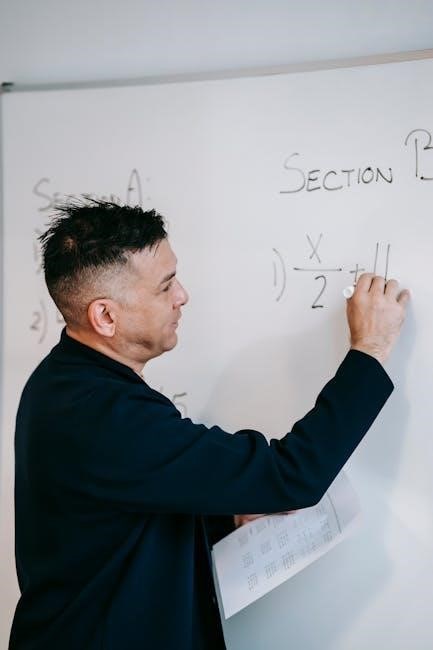
Modeling plays a vital role, with teachers demonstrating problem-solving strategies step-by-step. Guided practice follows, where students work through problems with teacher support, receiving immediate feedback. This minimizes errors and reinforces correct procedures.
Crucially, DI emphasizes procedural fluency alongside conceptual understanding. Students aren’t just taught how to solve a problem, but why the method works. Finally, constant assessment and data-driven adjustments are integral to ensure all students master the material.
Historical Context of Direct Instruction
The roots of Direct Instruction (DI) trace back to the work of educators like Engelmann and Carnine in the 1960s, responding to concerns about achievement gaps, particularly for disadvantaged students. Initially developed for basic skills instruction, DI emerged as a counterpoint to more open-ended, discovery-based approaches prevalent at the time.
Early DI programs focused heavily on scripted lessons and precise teacher behavior, aiming for consistency and maximizing learning efficiency. Throughout the 1970s and 80s, DI gained prominence, demonstrating significant positive effects in numerous studies, especially in mathematics.
However, it also faced criticism for its perceived rigidity. Despite this, DI principles continue to influence math instruction today, informing structured approaches and emphasizing explicit teaching of procedures. Modern adaptations often balance scripted elements with teacher flexibility, acknowledging the importance of responsiveness to student needs.

Comparing Direct Instruction to Other Math Teaching Methods
Direct Instruction contrasts with inquiry-based learning and constructivism, differing in its teacher-led, scripted approach versus student exploration and knowledge construction.
It’s more explicit than simply ‘explicit instruction’, emphasizing controlled practice.
Direct Instruction vs. Inquiry-Based Learning
Direct Instruction (DI) and inquiry-based learning represent fundamentally different pedagogical approaches to mathematics education. DI is characterized by a teacher-led, highly structured format where concepts are explicitly taught, modeled, and practiced with immediate feedback. Students respond in unison, reinforcing procedural fluency.
Conversely, inquiry-based learning prioritizes student exploration and discovery. Learners are presented with a problem or question and encouraged to investigate, formulate hypotheses, and construct their own understanding. This method emphasizes conceptual understanding and problem-solving skills, but can be less effective for students lacking foundational skills.
While DI excels at building procedural competence, inquiry-based learning fosters deeper conceptual understanding. A key difference lies in control: DI maintains tight teacher control, while inquiry-based learning empowers student autonomy. Effective mathematics instruction often benefits from a blend of both approaches, strategically employing DI to establish foundational skills and then transitioning to inquiry-based activities to promote deeper learning.
Direct Instruction vs. Constructivism
Direct Instruction (DI) and constructivism offer contrasting philosophies regarding how students learn mathematics. DI posits that knowledge is transmitted from teacher to student through explicit teaching of skills and procedures, emphasizing a structured, sequential approach. It prioritizes mastery of foundational concepts before moving to more complex topics.
Constructivism, however, asserts that learners actively construct their own understanding through experience and reflection. Knowledge isn’t passively received but built upon prior knowledge and social interaction. This approach favors student-led exploration and problem-solving, often minimizing direct teacher instruction.
The core difference lies in the role of the teacher: DI positions the teacher as the primary knowledge source, while constructivism views the teacher as a facilitator. While constructivism can foster deeper understanding, DI proves more effective for students needing explicit guidance and structured practice, particularly those with lower prior attainment; A balanced approach, integrating elements of both, can optimize learning outcomes.
Direct Instruction vs. Explicit Instruction – Key Differences
Though often used interchangeably, Direct Instruction (DI) and Explicit Instruction possess subtle yet significant distinctions. Explicit Instruction focuses on a clear sequence of teacher-led steps, modeling, and guided practice, ensuring students understand how to perform a skill. It’s adaptable and doesn’t necessarily rely on pre-packaged materials.
Direct Instruction, however, is a specific, trademarked program with highly scripted lessons and a rigid adherence to a predetermined sequence. It demands precise teacher delivery and immediate choral responses, prioritizing speed and accuracy. DI emphasizes a “parrot back” approach, where students verbally reiterate procedures.
Essentially, all DI is explicit, but not all explicit instruction is DI. Explicit instruction is a broader category, while DI represents a highly formalized, scripted implementation. The key difference lies in the level of scripting and the emphasis on precise, controlled student responses.

Key Components of a Direct Instruction Math Lesson
DI math lessons feature clearly defined objectives, step-by-step procedures, and teacher modeling, followed by guided practice with immediate feedback and independent application.
Clear Learning Objectives & Explicitly Stated Goals
Direct Instruction (DI) hinges on meticulously defined learning objectives, communicated with absolute clarity to students at the lesson’s outset. These goals aren’t merely stated; they are explicitly articulated, leaving no room for ambiguity regarding what students are expected to achieve.
This upfront transparency is crucial. Students need to understand precisely what new skills or concepts they will master during the lesson. The teacher doesn’t assume understanding; instead, objectives are often revisited and restated throughout the lesson to reinforce focus.
Furthermore, objectives are broken down into smaller, manageable steps. This scaffolding approach ensures students experience success at each stage, building confidence and solidifying their understanding. The explicit nature of these goals also facilitates accurate assessment of student learning, allowing teachers to tailor instruction accordingly.
Step-by-Step Procedures & Modeling
Direct Instruction (DI) emphasizes a highly structured approach where complex tasks are broken down into discrete, sequential steps. The teacher doesn’t simply present the solution; they meticulously demonstrate how to arrive at it, modeling the process with precision and clarity.
This modeling isn’t a one-time event. The teacher repeatedly demonstrates each step, often “thinking aloud” to verbalize their reasoning and problem-solving strategies. This allows students to observe not just what to do, but why they are doing it.
The scripted nature of many DI programs ensures consistency in these procedures. Students are then guided through similar problems, with the teacher providing support and correction as needed. This gradual release of responsibility, from teacher modeling to guided practice, is a hallmark of effective DI.
Guided Practice with Immediate Feedback
Guided practice is a cornerstone of Direct Instruction (DI), bridging the gap between teacher modeling and independent work. Following explicit demonstration, students engage in similar problems with the teacher’s support. This isn’t simply assigning practice; it’s a carefully orchestrated process of active participation.
Crucially, DI prioritizes immediate feedback. The teacher doesn’t wait for completed worksheets; they circulate, observe, and provide corrections in real-time. This allows students to address misconceptions instantly, preventing errors from becoming ingrained.
A key technique involves “controlled responding,” where the teacher asks questions and expects a chorus of answers from the class. This ensures all students are actively engaged and provides a quick check for understanding. Correct responses are reinforced, while incorrect ones are immediately addressed through re-teaching or further modeling.
Independent Practice & Application

Independent practice in Direct Instruction (DI) isn’t simply busywork; it’s a deliberate step to solidify learning after guided practice. Students work on similar problems, but now without direct teacher support, demonstrating mastery of the skill. This phase confirms whether the concept has been truly internalized.
The key is a gradual release of responsibility. Assignments are carefully designed to be achievable, building confidence and preventing frustration. However, it’s not solely about repetition. DI also incorporates application – problems that require students to use the newly learned skill in slightly different contexts.
This application phase is vital for developing true understanding and transferability. It moves beyond rote memorization, encouraging students to think critically and problem-solve. Regular review of previously learned material is also integrated to maintain procedural fluency.

Implementing Direct Instruction in Key Stage 3 Mathematics
Key Stage 3 benefits from Direct Instruction via programs like Connecting Maths Concepts (CMC), delivered 3-5 times weekly for 70-minute lessons.
These lessons balance teacher-led instruction with focused independent work.
The Connecting Maths Concepts (CMC) Programme
The Connecting Maths Concepts (CMC) programme represents a focused approach to Direct Instruction in mathematics, specifically designed for Key Stage 3 students – those in Years 7, 8, and 9, aged 11-14 – who demonstrate low prior attainment. This pilot programme, implemented in English schools, aimed to assess the feasibility and promise of CMC as a replacement for typical mathematics lessons.
A core feature of CMC is its structured delivery schedule: lessons are administered three to five times each week over a 15-week period. Each session is carefully timed, allocating 50 minutes to teacher-led Direct Instruction, ensuring explicit explanations and guided practice. The remaining 20 minutes are dedicated to independent work, allowing students to apply learned concepts and solidify their understanding.
This balanced approach aims to build both procedural fluency and conceptual understanding, addressing key areas where students may struggle. The programme’s design prioritizes systematic instruction, providing a clear pathway for students to progress in their mathematical skills.
Lesson Structure: Teacher-Led Instruction & Independent Work
Direct Instruction lessons, particularly within programmes like Connecting Maths Concepts (CMC), follow a deliberate structure maximizing student learning. The initial phase, comprising the majority of the lesson time – approximately 50 minutes – is dedicated to teacher-led instruction. This segment involves explicit explanations of mathematical concepts, step-by-step modeling of problem-solving techniques, and frequent checks for understanding through questioning and guided practice.
Following this intensive instruction, students transition to a 20-minute period of independent work. This phase allows them to apply the newly acquired skills and knowledge to a range of problems, reinforcing their learning and building confidence. This independent practice isn’t left unsupervised; teachers circulate, providing targeted support and immediate feedback.
This blend of direct teaching and independent application is crucial for solidifying understanding and promoting long-term retention of mathematical concepts.
Duration & Frequency of DI Lessons (70 minutes, 3-5 times/week)

Direct Instruction (DI) programmes, like the Connecting Maths Concepts (CMC) initiative, demonstrate a specific approach to lesson timing and frequency for optimal impact. Lessons are intentionally designed to be 70 minutes in duration, providing sufficient time for thorough teacher-led instruction, guided practice, and independent application of skills.
The CMC pilot program, implemented in Key Stage 3 schools, advocated for delivering these lessons three to five times per week. This consistent exposure reinforces learning and allows students to build procedural fluency through repeated practice. The structured schedule ensures concepts are revisited and consolidated, preventing skill decay.
This frequency and duration are not arbitrary; they are based on research indicating that consistent, focused instruction yields the most significant gains, particularly for students with lower prior attainment in mathematics.

Benefits of Direct Instruction in Mathematics
Direct Instruction fosters improved procedural fluency, enhances conceptual understanding, and proves particularly effective for students who begin with lower prior mathematical attainment.
It builds a strong foundation.
Improved Procedural Fluency
Direct Instruction (DI) excels at building procedural fluency in mathematics, a cornerstone of mathematical competence. The highly structured, step-by-step approach ensures students master fundamental skills through repeated practice and immediate feedback.
This isn’t simply rote memorization; it’s about developing automaticity with essential procedures, freeing up cognitive resources for higher-level thinking.
The scripted nature of DI lessons, with clear teacher modeling and guided practice, minimizes confusion and maximizes efficient learning. Students are explicitly taught how to solve problems, and then given ample opportunity to practice those skills until they become ingrained.
This focus on procedural fluency is especially beneficial for students who struggle with mathematics, providing them with a solid foundation upon which to build more complex understanding. It’s a critical component of successful mathematics education, and DI delivers it effectively.
Enhanced Conceptual Understanding
While often associated with procedural skills, Direct Instruction (DI) also fosters enhanced conceptual understanding in mathematics. Modern DI programs, like those detailed in Direct Instruction Mathematics by Stein et al., incorporate systematic procedures for addressing both aspects of mathematical proficiency.
It moves beyond simply teaching how to solve a problem to explaining why the method works.
Through careful sequencing of lessons and explicit connections between procedures and underlying concepts, DI helps students build a robust mental model of mathematical ideas. This isn’t about abstract theorizing, but about grounding concepts in concrete examples and practical applications.
Program evaluation procedures emphasize ensuring conceptual understanding alongside procedural fluency, creating a balanced approach. This leads to a deeper, more meaningful grasp of mathematics, enabling students to apply their knowledge in novel situations and solve complex problems effectively.
Effective for Students with Low Prior Attainment
Direct Instruction (DI) demonstrates remarkable effectiveness for students entering mathematics with low prior attainment. The highly structured and explicit nature of DI provides a crucial scaffold for learners who may struggle with more open-ended or inquiry-based approaches.
The step-by-step procedures and constant teacher modeling minimize ambiguity and ensure all students can follow along.
The Connecting Maths Concepts (CMC) programme, piloted by the EEF, specifically targeted Year 7-9 pupils with low prior attainment, replacing usual lessons with 70-minute DI sessions. This focused intervention aimed to build foundational skills and confidence.
DI’s emphasis on mastery – ensuring students can accurately perform procedures before moving on – is particularly beneficial for those who have gaps in their knowledge. It provides a pathway to success, building momentum and fostering a positive attitude towards mathematics.

Evaluating Math Programs Using Direct Instruction Principles
Systematic procedures are vital when evaluating math programs, focusing on both conceptual understanding and procedural fluency, as outlined in Direct Instruction Mathematics resources.
Assess alignment with DI’s core principles.
Systematic Procedures for Program Evaluation
Evaluating math programs utilizing Direct Instruction (DI) principles demands a rigorous, multi-faceted approach. Begin by clearly defining the program’s stated objectives and comparing them to the core tenets of DI – explicit instruction, teacher-led modeling, guided practice, and immediate corrective feedback.
Next, assess the program’s scripting and level of teacher direction. True DI programs are highly scripted, minimizing ambiguity and ensuring consistent delivery. Observe lessons to verify adherence to the script and the extent to which teachers facilitate rather than discover learning.
Analyze the program’s assessment methods. DI emphasizes frequent, formative assessments to monitor student progress and adjust instruction accordingly. Look for programs that incorporate regular opportunities for students to demonstrate mastery of skills. Finally, examine the program’s provisions for addressing both procedural fluency and conceptual understanding, as highlighted in resources like Direct Instruction Mathematics, ensuring a balanced approach to mathematical development.
Addressing Conceptual Understanding and Procedural Fluency
Direct Instruction (DI) doesn’t solely prioritize rote memorization; a robust DI math program systematically builds both procedural fluency and conceptual understanding. Initial instruction focuses on establishing clear, step-by-step procedures, enabling students to accurately perform calculations. However, this is not the endpoint.
Effective DI programs then layer in explanations of why the procedures work, connecting them to underlying mathematical principles. This might involve visual models, real-world applications, or explicit discussions of mathematical properties.
Direct Instruction Mathematics resources emphasize procedures for achieving this balance, ensuring students aren’t merely mimicking steps but grasping the logic behind them. Frequent assessments, integral to DI, allow teachers to identify gaps in either area and provide targeted remediation. The goal is to cultivate a deep, interconnected understanding of mathematical concepts, not just the ability to follow algorithms.
Resources and Tools for Direct Instruction in Math
Direct Instruction benefits from specialized materials like the Direct Instruction Mathematics textbook series, Enhanced Pearson eText, and programs from McGraw Hill.
These resources offer scripted lessons, video demonstrations, and systematic evaluation procedures.
Direct Instruction Mathematics Textbook Series
The Direct Instruction Mathematics textbook series represents a cornerstone resource for educators committed to this pedagogical approach. Developed by Stein, Kinder, Silbert, Carnine, and Rolf, these materials are meticulously designed to deliver explicit, step-by-step instruction in core mathematical concepts.
These textbooks aren’t simply content repositories; they are integral components of a comprehensive DI system, providing detailed scripts for teachers, ensuring consistency and fidelity of implementation. The series covers a broad range of mathematical topics, from foundational arithmetic to more advanced algebraic concepts.
A key feature is the emphasis on mastery learning, with ample opportunities for guided practice and immediate feedback. The textbooks also include procedures for evaluating student progress and adjusting instruction accordingly, aligning with the Common Core State Standards (CCSS) and addressing both conceptual understanding and procedural fluency.
Enhanced Pearson eText & Video Demonstrations
Pearson significantly enhances the Direct Instruction Mathematics experience through its Enhanced Pearson eText platform. This digital resource provides interactive features designed to support both teachers and students, extending the reach of traditional textbooks.
Crucially, the eText includes direct links to video demonstrations of teaching formats. These videos are invaluable for professional development, allowing educators to observe experienced teachers implementing DI strategies effectively. They showcase the precise scripting, questioning techniques, and pacing characteristic of the method.
The video demonstrations cover a wide array of mathematical topics, offering practical examples for various grade levels and skill areas. This visual component complements the textbook’s detailed instructions, providing a powerful tool for teacher training and ensuring fidelity to the DI model. It’s a dynamic resource for mastering the nuances of effective direct instruction.
McGraw Hill Direct Instruction Programs
McGraw Hill offers a comprehensive suite of Direct Instruction (DI) programs designed to improve student outcomes in mathematics. These programs are built upon decades of research demonstrating the effectiveness of DI, particularly for students who require explicit and systematic instruction.
Leveraging field-tested materials, McGraw Hill’s DI programs provide teachers with detailed lesson plans, scripted instruction, and ongoing assessment tools. The focus is on building strong foundational skills through carefully sequenced lessons and frequent opportunities for guided and independent practice.
These programs are particularly valuable for addressing learning gaps and accelerating student progress. McGraw Hill emphasizes a proven and reliable approach, ensuring consistent implementation of DI principles across classrooms. They aim to provide a structured learning environment where all students can succeed in mathematics.